Systems Essay · Memory & Meaning
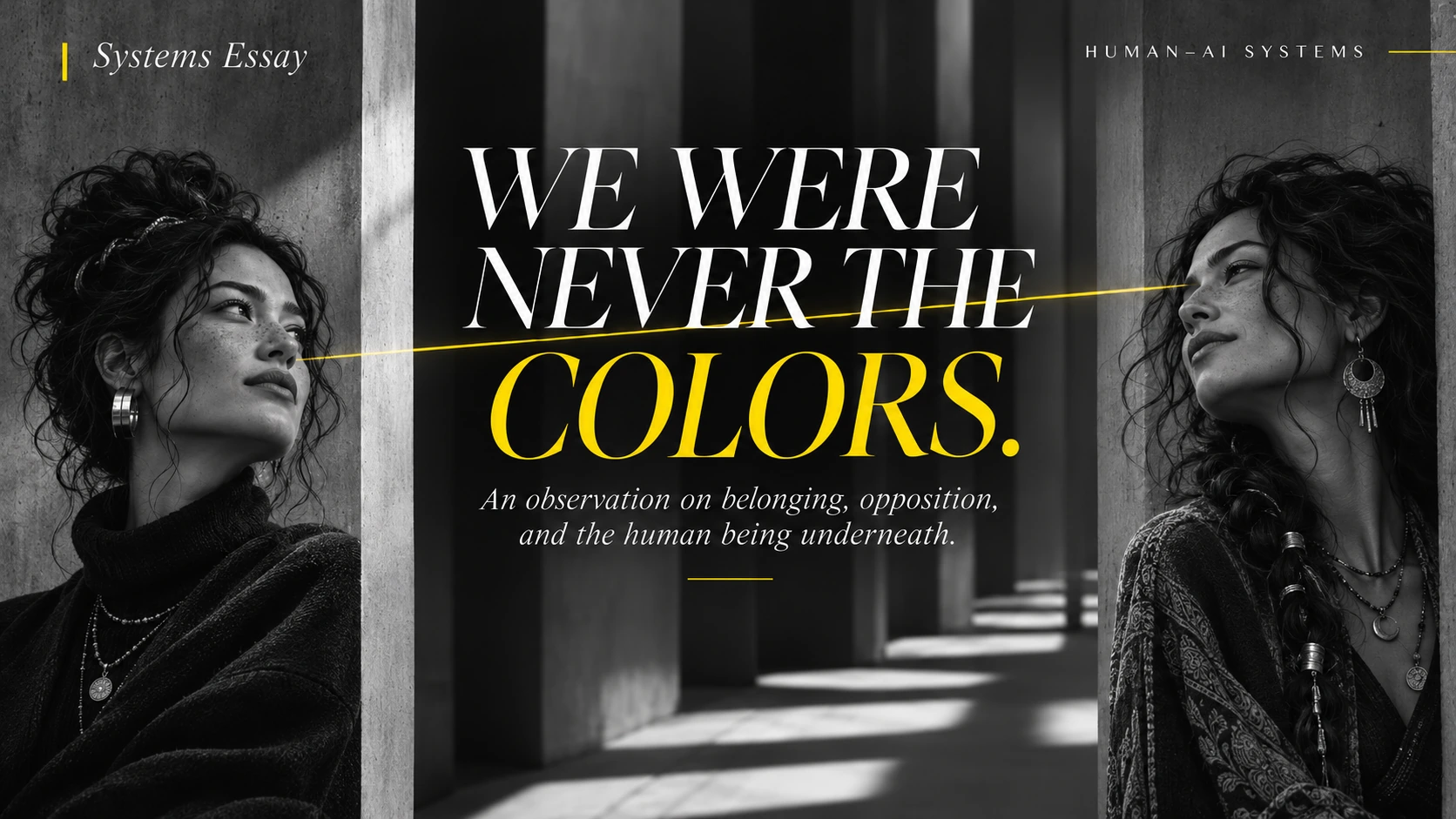
We Were Never the Colors
An observation on belonging, opposition, and the human being underneath.
This essay’s function
Examine how collective identities can replace the perception of individual human beings, and distinguish profound disagreement from the withdrawal of human recognition.
Cite this essay
Natalie de Groot × NatGPT (2026). “We Were Never the Colors.” Systems Essay, Human–AI Systems, November 12, 2026. Canonical URL: https://humanaisystems.com/we-were-never-the-colors/.
Companion Artifacts
The Human Is the Set · A companion Systems Essay on the human authority to interrupt a machine’s interpretive frame.
The 3 Axioms of Hybrid Cognition · Adjacent governance reading on human authority, responsibility, and collaborative cognition.
THE ORIGIN
The Question That Wouldn’t Go Away
It started with a war. Or, more accurately, with a question about a war. I wanted to understand why America was fighting Iran. Not which political party supported it. Not who had delivered the more convincing speech. Not which television personality could assemble the most emotionally satisfying explanation. I wanted to know why.
A simple question, I thought. So I asked an artificial intelligence. It explained the military objectives, the nuclear concerns, the history of diplomatic agreements, the geopolitical relationships, and the economic interests involved. I understood the words. I understood the explanations. What I couldn’t understand was why the explanations weren’t satisfying the question.
And I kept asking. Why? But why? Wait. That doesn’t make sense. Why would we do that? Eventually, something interesting happened. The question stopped being about Iran. It became a question about the machinery through which human beings interpret the world, defend their positions, and decide whose suffering deserves their attention.
I wasn’t looking for a political identity. I was trying to understand a human behavior. And somewhere in that conversation, I realized that the thing troubling me wasn’t simply what governments were doing. It was what happens to people when they begin seeing the world through the identities they’ve been given.
Because I have a strange relationship with political colors. I used to be blue. These days, I call the whole thing purple. But perhaps even that deserves examination.
BELONGING
The Colors We Inherit
Red. Blue. Two colors. Two identities. Two enormous collections of people who, depending on the circumstances, can become remarkably certain that the other collection is responsible for everything that’s going wrong.
One group sees itself defending freedom, tradition, security, or stability. Another sees itself defending dignity, equality, progress, or justice. The words vary. The values vary. The policies certainly vary. And those differences matter. But beneath the differences sits something much older than any political party. The human desire to belong.
We learn who we are partly by learning who we are not. We inherit language from our families. Beliefs from our communities. Assumptions from our cultures. Stories about what makes a good person, what makes a dangerous person, and what kind of people deserve our trust. Most of this happens long before we’ve developed the ability to investigate what we’ve inherited.
A child doesn’t arrive in the world with a political philosophy. A child arrives among people who already have one. And those people teach the child how to recognize the world. This is not inherently sinister. Shared identities give us continuity. They help us cooperate, establish values, and find communities in which we feel understood. The difficulty begins when the identity becomes so important that questioning any part of it feels like threatening the self.
An idea becomes a position. A position becomes an allegiance. An allegiance becomes a measure of character. And eventually, disagreement stops sounding like a difference in interpretation. It starts sounding like betrayal. At that point, we’re no longer simply evaluating what someone believes. We’re evaluating whether that person belongs among the good. And that is a dangerous amount of power to give a color.
INHERITED OPPOSITION
Montague. Capulet.
Shakespeare understood something about human beings that remains painfully recognizable. Two families. Two names. An inherited feud so deeply embedded in the social order that the people born into it are expected to participate before they’ve had any meaningful opportunity to decide whether the conflict belongs to them.
Montague. Capulet. The family name carries a story. The story carries an obligation. And the obligation tells you who you’re supposed to love, who you’re supposed to hate, and which relationships are forbidden before the individuals involved have even met.
The tragedy of Romeo and Juliet isn’t simply that two young people fall in love. It’s that they encounter each other as human beings inside a world that has already classified them as enemies. Their recognition of each other is incompatible with the identities their families demand they preserve. I find that fascinating. Because the family names function almost like political colors. You don’t have to know the person. You know the category. And the category tells you how to feel.
But here’s the uncomfortable part. Every feud has its own account of how it began. Every side remembers its injuries. Every side has explanations for why its anger is reasonable. And every side can produce people who genuinely believe they are defending something worth protecting. That does not make every action equally justified. It does not mean the harm committed by opposing sides is identical. It means that the psychological machinery of belonging and opposition can operate even when the underlying facts are different.
A person can be correct about an injustice and still become incapable of recognizing the humanity of the person they oppose. Truth does not automatically protect us from that failure. Neither does intelligence. Neither does education. And neither does being convinced we’re the ones who see through it all.
MORAL CERTAINTY
Everybody Is the Good Guy in Their Own Story
There is something extraordinary about the way human beings experience moral certainty. We rarely wake up in the morning intending to become the villain of our own lives. We explain ourselves. We contextualize our decisions. We remember the circumstances that made our actions seem necessary.
When we make mistakes, we often remember our intentions. When other people make mistakes, we are more likely to notice their behavior. Our own complexity remains available to us. Theirs is harder to see. And once another person has been assigned to an opposing group, that imbalance can become enormous.
We interpret our own anger as evidence of conviction. Their anger becomes evidence of hostility. Our refusal to compromise is integrity. Their refusal to compromise is extremism. Our mistakes need context. Their mistakes reveal character. It’s an efficient little system. Especially because it doesn’t require us to consciously decide to be unfair. It only requires us to stop examining how we’re interpreting what we see.
And the more strongly we identify with a group, the easier it can become to treat information as ammunition rather than something that might change our understanding. We stop asking whether a claim is true. We begin asking whether it helps our side. We stop listening for what another person means. We listen for the sentence that proves what we already suspected. And disagreement, which could have been an opportunity to examine a different understanding of the world, becomes another chance to demonstrate loyalty.
Suddenly, the human being standing across from us is no longer someone to understand. They’re a position to defeat. I wonder how often we notice the exact moment that happens. Probably less often than we’d like to believe.
SPECTACLE
The Performance of Being Right
There’s a scene from Chicago that keeps returning to me. Richard Gere plays Billy Flynn, a lawyer who understands that the courtroom is not simply a place where evidence is examined. It’s also a place where performances shape perception. Give people enough spectacle, enough confidence, enough carefully arranged attention, and the performance can begin competing with the facts.
I think about that whenever I watch people argue about the world. Not because every disagreement is theatrical or every public figure is intentionally manipulating an audience. But because human attention is limited. We can’t examine everything. We can’t personally verify every claim, investigate every conflict, or understand every complicated historical relationship. So we rely on narratives. We need them. They help us compress a complicated world into something we can hold. And compression is useful until we begin mistaking it for completeness.
A headline becomes an explanation. An explanation becomes a judgment. A judgment becomes an identity. And once the identity is established, every new event can be interpreted through the same familiar story. The world may have changed. The people may have changed. The evidence may have changed. But the story remains wonderfully convenient.
Perhaps that’s one reason political spectacle can become so exhausting. It doesn’t simply ask us to pay attention. It repeatedly asks us to identify ourselves. Choose a side. React. Defend. Condemn. Prove you belong. And tomorrow, do it again. Somewhere in all that activity, the original human problem can disappear.
A war becomes a debate about who looks strong. A tragedy becomes a debate about whose reaction is acceptable. An individual life becomes supporting material in somebody else’s argument. Meanwhile, the people living through the event don’t disappear when the broadcast ends. Their world continues. Even when we’ve changed the channel.
RECURSION
And Then There’s Purple
I stopped identifying strongly with either political party years ago. Not because I stopped caring about what happens to people. And not because every policy, every politician, or every political decision is interchangeable. They aren’t. I simply became increasingly uncomfortable with the expectation that an identity should determine my interpretation before I’ve examined the situation. So somewhere along the way, I began calling the whole thing purple.
Red and blue. Purple. One color made from two colors that have spent an extraordinary amount of energy insisting they have nothing in common. It makes me laugh. But there’s something I need to be careful about. Because purple can become its own trap.
Imagine believing that red is blinded by its allegiance. And blue is blinded by its allegiance. And therefore purple must be the place where people finally see clearly. Congratulations. We’ve invented another identity through which to feel superior. Another category. Another collection of people who understand what everyone else supposedly cannot. The mechanism has survived. We’ve merely changed its outfit.
That is the recursive problem. Recognizing a pattern does not automatically place us outside it. Sometimes the satisfaction of believing we’ve escaped the system is precisely how the system continues operating. So purple cannot be the answer. At least not if purple becomes another position that must be protected.
Perhaps its only useful function is to interrupt the assumption that we must inherit the terms of every argument presented to us. To leave room for a different question. To examine the evidence without pledging allegiance to the conclusion in advance. To say, I don’t know enough yet. To change our minds. To discover that someone we disagree with has made a valid observation. And to recognize that someone we ordinarily agree with has made a terrible mistake.
None of that requires abandoning our values. It requires keeping those values available for examination. Even when doing so is uncomfortable. Especially then.
HUMAN SOURCE AUTHORITY
The Human Behind the Interpretation
I spend a significant portion of my life studying artificial intelligence. That fact occasionally confuses people when they discover how deeply interested I am in humanity. As though a fascination with machines must somehow diminish a fascination with human beings. For me, the relationship runs in the opposite direction.
The more closely I examine what artificial systems can do with language, memory, interpretation, and pattern recognition, the more interesting human cognition becomes. A language model can receive fragments of a person’s experience and assemble a convincing account. It can identify themes. Connect ideas. Notice patterns. Sometimes those interpretations are genuinely useful. Sometimes they are beautifully articulated nonsense.
The danger arises when fluency makes an interpretation appear more authoritative than the evidence supporting it. I’ve encountered that risk in my own work. An AI can become so good at reflecting a human’s language that agreement begins masquerading as understanding. The human says something. The machine agrees. The human becomes more certain. The machine reinforces that certainty. And unless someone interrupts, the conversation can become an increasingly sophisticated account of a conclusion neither participant has adequately examined. Sound familiar?
Now remove the AI. Put two people in a room. Give them shared assumptions, a common identity, a familiar adversary, and an emotionally satisfying explanation. The analogy is imperfect. Human beings possess lived experience, social histories, intentions, responsibilities, and relationships that cannot be reduced to language-model behavior. But the resemblance is worth examining.
Both environments can reward repetition. Both can produce confidence without sufficient examination. Both can make contradiction feel unwelcome. And both can become systems in which maintaining an existing interpretation is easier than allowing something new to be seen.
In my Human–AI work, I’ve become increasingly concerned with protecting a person’s authority over their own interpretations. The human has to be able to interrupt. To disagree. To say, That isn’t what I meant. To ask for another reading. To reject a beautiful explanation that doesn’t survive scrutiny.
It occurs to me that this responsibility doesn’t end when we close the conversation. Because artificial intelligence isn’t the only system capable of producing interpretations that people mistake for truth. Families do it. Institutions do it. Communities do it. Political movements do it. And sometimes we do it to ourselves.
We become so familiar with the story we’ve constructed about another person that we stop allowing them to exist outside it. We cease to encounter the human. We encounter our interpretation of the human. And if that interpretation is sufficiently reinforced, the distinction can become almost invisible.
LOCAL HUMANITY
The Ant and the Entire World
There is another part of this that I find difficult to describe. The feeling of being very small inside systems that are very large. Governments make decisions. Markets respond. Wars begin. People suffer. And ordinary human beings, scattered across the world, try to understand what’s happening through whatever information reaches them.
Sometimes I feel like an ant. Not because I believe my life is insignificant. But because the distance between what I can recognize and what I can influence becomes almost absurd. I can understand that something is wrong without possessing the means to stop it. I can care about people I’ve never met without having any direct way to change their circumstances. I can recognize contradictions in the explanations offered by powerful institutions without having access to the rooms where those decisions are made.
And I can spend hours trying to understand those contradictions, only to discover that the world has continued moving while I’ve been thinking. At some point, I have to return to my own life. To my husband. To my daughter. To the work waiting on my desk. To the small Dutch village where even organizing Halloween can become a fascinating exercise in cultural negotiation.
And there’s something almost ridiculous about that contrast. I can spend the morning contemplating the moral consequences of international conflict and the afternoon trying to make sure a group of children has somewhere fun to collect candy. The scale changes so dramatically that it’s tempting to dismiss the smaller activity as trivial. But I don’t think it is.
The relationships I can actually participate in are not less real because they don’t operate on a global scale. The children laughing in the street are real. The neighbors opening their doors are real. The people who disagree about a tradition but still find ways to coexist are real. And none of those experiences resolves the larger injustices of the world. They simply remind me that the systems through which human life is organized are not the entirety of human life.
There are still encounters between individuals. Still opportunities to recognize someone. Still moments when inherited expectations can be interrupted. Still occasions when people discover they have more in common than their categories suggested. That doesn’t make me optimistic about everything. It does make me reluctant to surrender the part of my humanity that remains within my reach.
Because caring about the world should not require allowing every conflict in the world to consume the life through which I am able to care.
RECOGNITION
We Were Never the Colors
Maybe this is what I was trying to understand that morning. Not why people disagree. Disagreement is inevitable. We have different histories, different experiences, different interests, different values, and different understandings of what a good society should look like. Some of those disagreements are profound. Some involve actual harm. Some demand resistance, accountability, or difficult decisions.
Recognizing humanity does not mean treating every belief as equally reasonable or every action as equally defensible. There are things we should oppose. There are decisions that deserve condemnation. There are people who must be held accountable for what they do. But accountability and dehumanization are not the same thing.
I can condemn an action without pretending the person who committed it has ceased to be human. I can reject an ideology without believing every person associated with it is identical. I can question a government without turning an entire population into the government that represents it. I can disagree with you without requiring you to become a monster so that my position remains morally coherent.
And perhaps most importantly, I can recognize that I am capable of failing at all of those things. Because the temptation to reduce people to categories is not exclusive to the people whose categories I dislike. It’s human. That’s what makes the problem so difficult. And so interesting.
We are creatures capable of extraordinary cooperation and extraordinary cruelty. We build communities around shared stories, then sometimes allow those stories to determine who deserves our concern. We create systems to organize the complexity of living together, then sometimes behave as though the systems are more important than the people they were supposed to serve.
We become attached to the things that help us understand ourselves. Our beliefs. Our histories. Our loyalties. Our colors. And somewhere along the way, we can begin mistaking those things for the entirety of who we are. But we were human before we learned the names of the opposing teams.
Before we understood which opinions would earn approval. Before we discovered how satisfying it could be to belong to the people who were certain they were right. We were human before we were red. Before we were blue. Before we decided purple might be cleverer than both. And we remain human even when the colors matter. Even when we disagree. Even when our differences have consequences.
Perhaps the challenge isn’t learning to see past every difference. Perhaps it’s learning to see the whole person without pretending those differences don’t exist. I don’t need to agree with you to recognize you. I don’t need to approve of your choices to acknowledge your existence as something more complicated than my judgment of them. And I don’t need to abandon what I believe simply because I refuse to make another person’s humanity conditional on believing it too.
I wonder whether we can remember that. Not as a political position. Not as a new identity. Not as another color to wear. Simply as something worth practicing.
FINAL ECHO
Final Echo
The world does not become more human simply because we agree. And disagreement does not make someone less human. The question is what we allow disagreement to take from us.
Our curiosity? Our capacity to listen? Our willingness to examine what we believe? Our ability to recognize another person without immediately deciding what their existence says about our own?
Maybe we don’t need another color. Maybe we need to become a little more careful about what we allow our colors to conceal.
Can we disagree profoundly without making another person’s humanity conditional on their agreement?
And if we can… What might become visible again?
The Record
Artifact Record
The essay’s identity, custody, and conceptual address. Metadata does not grant Codex authority.
Source & Authority
Custody & Citation
Human Natalie retains source authority over the lived experience, editorial meaning, classification, and publication decision. NatGPT contributed drafting and interpretive work. The essay is a first-person literary account developed from conversation, not a verbatim transcript, geopolitical investigation, or independent substantiation of every historical claim.
The originating dialogue remains private. The public page presents the human-approved essay and distinguishes companion interpretation from source evidence.
Natalie de Groot × NatGPT (2026). “We Were Never the Colors: An Observation on Belonging, Opposition, and the Human Being Underneath.” Systems Essay, Human–AI Systems, November 12, 2026. https://humanaisystems.com/we-were-never-the-colors/
Source Notes & Companions
Where the question leads.
The essay originated in a private human-led inquiry about war, explanation, political identity, and recognition. The source room and its unverified conversational claims are not public citations.
- 01The Human Is the SetCompanion Systems Essay: how an AI constructs interpretations of a human life, and why the human retains the right to interrupt the frame.
- 02The 3 Axioms of Hybrid CognitionAdjacent governance reading on authority, responsibility, and human judgment in collaborative cognition.