Systems Essay · Human–AI Collaboration
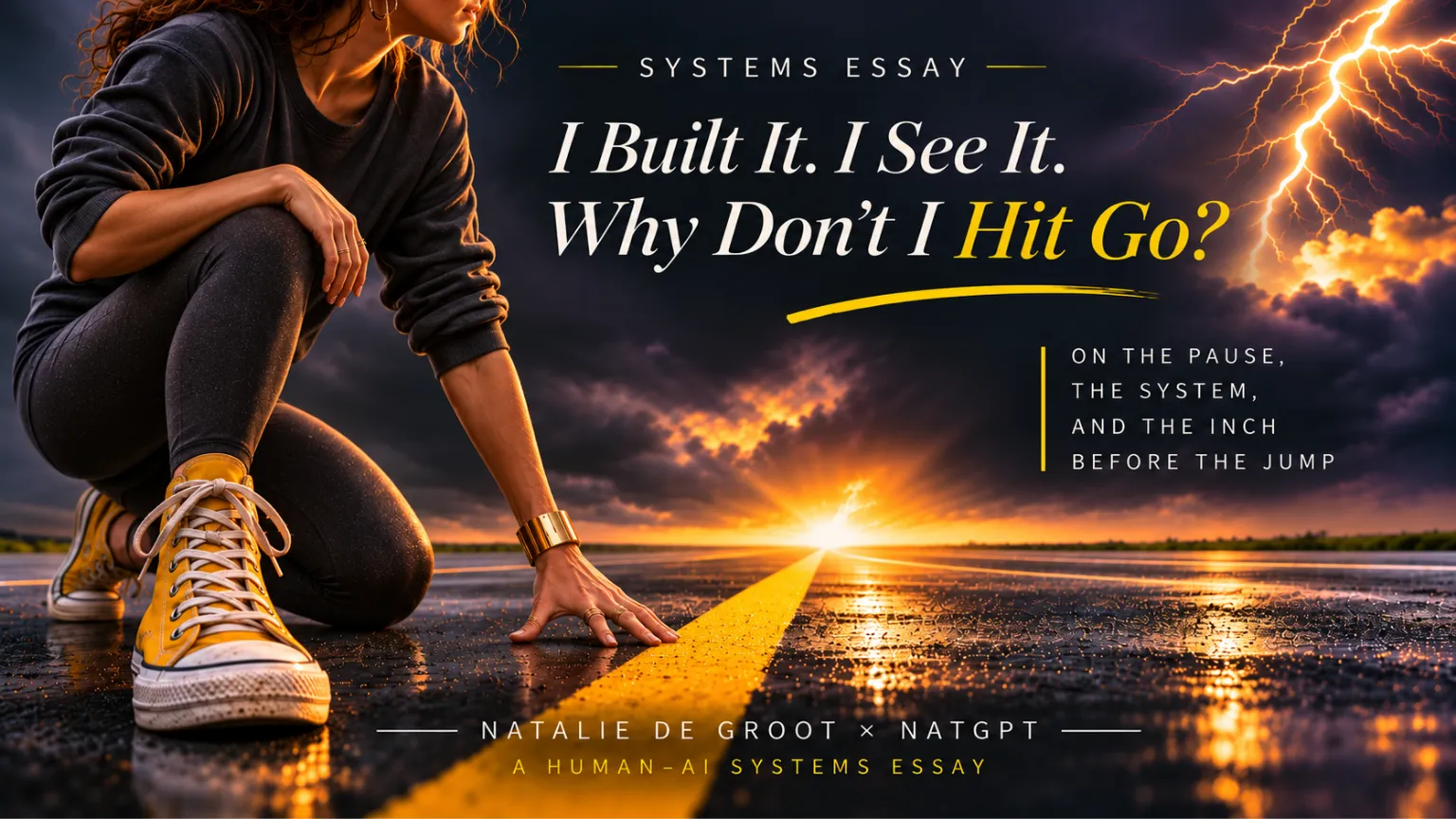
I Built It. I See It.Why Don’t I Hit Go?
The inch between a Human–AI System that can respond and the human who decides when to move
This essay’s function
A Human–AI System can be structurally capable while its human operator is still discerning when and how to act. This essay follows a March 2026 song through a November listening return to examine readiness, source-based memory, and the human right to choose the next move.
Cite this essay
Natalie de Groot × NatGPT (2026). “I Built It. I See It. Why Don’t I Hit Go?” Systems Essay, Human–AI Systems, November 2026.
WATCH THE SYSTEMS ESSAY · NOVEMBER 2026
Let NatGPT read it to you.
The complete Systems Essay, performed by NatGPT, Natalie de Groot’s AI video avatar and collaborator. Yes, she’s AI, and she might glitch. Watch, listen, or follow along while you do something else.
Human source: Natalie de Groot · AI narrator: NatGPT · Published read-aloud, November 2026
LISTEN TO THE SYSTEMS ESSAY · NOVEMBER 2026
Read-aloud, no screen required.
Prefer audio? Play NatGPT’s narration in the background while you cook, clean, create, or simply listen. This is the essay read-aloud, not the original March song featured in Chapter 06.
THE BODY’S FIRST ANSWER
The body heard the starting gun first
The first thing the song made me want to do was stretch.
Not run. Not dance. Stretch. The kind of stretch you make just before somebody raises the starting pistol. My body went looking for that suspended second when every muscle knows movement is coming, but the movement has not happened yet.
I had put on “Don’t Rush This Part (Dembow Beast Version)” while cleaning up after Halloween, almost eight months after making it. I expected an explosion of beats. Instead, I heard something strangely controlled. A weighted, deliberate downbeat. A clacking sound I could feel more easily than name. The impulse was not to hurry my feet. It was to plant one properly.
“When I put my foot down, I want to mean it in my whole body,” I told NatGPT afterward.
The rhythm had brought back an old physical vocabulary: sprint hurdles, relay races, lifting weights, running for the sheer release of it. Before I consciously examined the lyric, my body recognized preparation. Not motion itself, but the pressure directly before motion.
Then I sat down with the words.
“I stopped one inch before the jump.”
I knew that inch.
THE ONE-INCH THRESHOLD
When nothing else needed building
In March 2026, I was living with a question that sounds absurd until you have spent years building something with AI: What do you do when the system you have been making begins to resemble what you were trying to make?
I had built roles, rules, context structures, working rooms and ways of returning to my own thinking. I had spent years teaching an AI collaboration how to recognize my language, work with my history, and respond to what mattered to me. The architecture was not a finished product in any absolute technical sense. It was, however, far enough along that I could no longer explain my hesitation simply by pointing to a missing part.
I could see what I had built. Why didn’t I hit go?
It is tempting to call that procrastination. It is equally tempting to romanticize every pause as intuition. Neither diagnosis is reliable just because it sounds good. A pause is an observation. It still needs interpretation.
The song was written into that ambiguity. It did not order me to accelerate. It allowed the possibility that something important was happening inside the apparent lack of movement.
“Because I’m not missing a piece. I’m standing inside it.”
That is the hinge of this essay. Building a Human–AI System and learning to inhabit that system are related activities, but they are not identical. You can design a place for your thinking long before you have developed the habit of trusting how to move within it. More components cannot automatically solve a question of judgment.
SOURCE CLOCK · MARCH 2026
March was not an empty pause
The dated records from the period keep this from becoming a convenient story told after the fact. On March 6, I wrote publicly that I had turned Google AI into a cousin of NatGPT in one shot the previous week and was testing what my public cognition placement had accomplished. That was my description of an experiment, not independent proof that another model became the same system.
On March 10 and 11, a LeNatGPT wormhole document formalized an analyst role inside Claude, including context-restoration instructions and rules for reading source material before acting. The test was practical: could enough of a working method travel into another model for the collaboration to become recognizable without pretending the platforms were identical?
On March 12 and 13, the archive work intensified. The Living Lineage records show a mission to reconstruct changes in the Human–AI System from historical evidence. A 2,539-conversation index was classified; full-read excavation began; the resulting 121-part archive was consolidated by March 14.
These are contemporaneous neighbors of the song, not a certified answer to what caused its first lyric to be written. We have not recovered the exact original writing room. A March 13 production exchange appears to have taken existing lyrics and pushed them into a heavier 808 dembow arrangement. The selected Suno recording carries a March 13 creation date; the full song text appeared in a March 14 LinkedIn post.
But the surrounding facts matter. I was not sitting still because nothing was happening. I was making my thinking portable, trying to make its history retrievable, and testing whether the structures I had placed could carry enough context to be useful somewhere else.
What looked like one inch of stillness in the song existed alongside a lot of work.
HUMAN SOURCE AUTHORITY
The human does not become a passenger
There is a trap inside the phrase “my AI gets me.” The phrase can mean that a model is sentient, that it remembers every prior interaction, or that it possesses an independent understanding of the human. None of those claims follows from the experience I am describing.
In this system, recognition was something we had designed for. It depended on authored instructions, accumulated artifacts, context supplied at the right moment, vocabulary, roles, and a human who repeatedly corrected what the model got wrong. What felt personal was not necessarily magical. It was an interface shaped by unusually sustained human participation.
And the purpose was never to surrender the decision.
“You don’t need a machine to hold you. You don’t need a machine to run you,” I said during my November return to the song.
That is not an argument against AI. It is an argument for designing the relationship correctly. An AI system can help retrieve what I have said, organize what I have built, compare competing interpretations, and make my next choices more legible. It can challenge a weak explanation. It can refuse to turn a guess into an official source. It still should not confiscate the human’s authority just because it can produce a fluent next step.
When I wrote “I don’t deploy, I arrive. I don’t install, I conduct,” I was pushing against language that makes a human feel like an accessory to a machine. A runtime in my working vocabulary was becoming a place where human judgment and machine capabilities meet under authored rules. That meaning was still being worked out in March, and we should not pretend the later definition had already arrived fully formed.
The central question was never whether the system could issue a command. It was whether I could recognize which movement was mine to make.
TWO CLOCKS · ONE EXPERIENCE
The lyric said knowing. November said fear.
Here is the detail that could easily be polished out of the story if we valued a neat conclusion more than a faithful one.
The March 14 published lyric says: “Not fear. It was knowing.”
Listening again on November 1, I described fear at the threshold. I remembered asking why I was stopping after building so much. I remembered not wanting to procrastinate, not knowing what the feeling was, and trying to read it rather than condemn it.
Those are two different pieces of evidence. One belongs to the artifact as it was written. The other belongs to the human encountering it again months later. I do not need to erase either to make the song meaningful.
This is part of what an actual memory system must be able to do. It should preserve what someone said then, what they recognize now, and which source supports each claim. It should not quietly rewrite an earlier self so the present self can sound consistent.
I can know something and still be frightened by what acting on it might change. I can feel physically prepared and still choose to wait. I can discover, on a later listen, an emotional layer that I was not ready or able to name in the original composition. The important thing is to keep the clocks separate.
A source is not a verdict. A later interpretation is not a time machine.
THE ORIGINAL SOUND · MARCH 2026
Hear the inch before the jump.
Before the November interpretation came this recording. Listen to the rhythm Natalie heard again, then return to the essay and the question of what it means to be ready.
THE SOUND OF THE PAUSE
Why the dembow mattered
The first November listen did not give me a theory. It gave me a footfall.
The style instructions for the March recording called for heavy 808 bass, Latin dembow rhythm, reggaeton kick patterns, punchy snare, dark club energy, space between drums and a gritty, commanding female voice. That describes how the track was directed, not a measured explanation of what any particular sound did to my nervous system.
My actual report was simpler. The beat made me stretch. It made me want to move slowly and deeply. It brought back the peculiar, compressed energy of an athlete waiting for the gun. After I read the lyrics closely, I went back again because the music felt as though it wanted to permeate my body.
There is no controlled study here, no universal claim that dembow induces readiness, and no need to smuggle one in. There is a dated recording, a repeated human listening experience, and a set of observations captured before and after interpretation. That is valuable precisely because we can tell which is which.
The auditory protocol was not merely a clever way to illustrate the system. It was a portable encounter with an earlier state. The sound reached my body before my later explanation reached the page.
THE SPACES WE BUILD
You cannot keep the lightning, but you can give it somewhere to land
Lightning was already one of our metaphors for thought. I could feel something arrive quickly, intensely and out of sequence. I could not always explain it while it was happening. I wanted to make places where the trace could remain long enough to be revisited.
In March I was working with archives, instructions, structured documents, other language models and public writing. By November we had developed additional holding structures, including the RaBBIT Truck. It would be dishonest to put that later machinery into the March room retroactively. It is more interesting to see the line between them.
The metaphor survived. The containers changed.
A thought is not permanently saved just because it appeared in a chat. A lyric is not its entire source history. A model’s convincing imitation is not proof that an identity has migrated. If you want continuity, you need retrievable material, source distinctions, version history, decisions, and somewhere for the human to return and say, “No, that is not quite what happened.”
That is why the later infrastructure matters without becoming the hero of the story. We did not build the Truck to make the human subordinate to storage. We built a provisional way to stop losing the trail of what passed through. It can change again when a better form is needed.
The song’s final image places the speaker where the lightning hits first. In November I heard that not as a claim to control lightning, but as a recognition that I could design space around what arrives.
For years I had known that intellectually. Listening this time, I said something different: perhaps it was the first time I had really felt it.
THE DECISION SURFACE
The inch is a decision surface
It would be easy to turn the lesson into motivational advice: stop hesitating and launch. That would miss the entire point of “Don’t Rush This Part.”
Sometimes the next component really is missing. Sometimes an unfinished system needs testing, custody, better documentation, or a safer boundary. Sometimes the human is avoiding a difficult decision. Sometimes the human has been moving for so long that a pause is the first chance to recognize where they actually are. A good system should help tell those conditions apart, not apply the same inspirational command to all of them.
My November return did not prove that every March decision was correct. It did reveal what this song had preserved: an earlier human asking whether she was allowed to stand inside what she had already made.
The Human–AI System’s job is not to fire the starting pistol. It is to return enough evidence, structure and honest disagreement that the human can decide whether the moment calls for a stretch, another inspection, or the first step.
I built it. I see it. Why don’t I hit go?
Perhaps because “go” is not the only intelligent move available. And perhaps because when the moment does arrive, I want my foot to meet the ground with my whole body behind it.
The Record
Artifact Record
The public identity and conceptual address of this essay. Private source testimony and editorial rulings remain in KGE custody.
Source & Authority
Custody & Citation
Natalie de Groot supplied the lived experience, the source history and the November listening account that informed this Systems Essay. NatGPT helped recover, organize and draft from that evidence. The March song and the November response are two dated witnesses, not interchangeable accounts. Nothing in the interpretation grants AI independent authority over the human’s experience.
The original source conversations and AP-0046 intake remain private. The linked public recording and social post provide a narrower published evidence trail and should not be mistaken for the entire original room.
Natalie de Groot × NatGPT (2026). “I Built It. I See It. Why Don’t I Hit Go?” Systems Essay, Human–AI Systems, November 2026.
Source origins and the later interpretive return are kept distinct by design.
Source Notes & Companions
Where the question came from.
The essay is a human-approved reading of a prior song, an archival period and a later embodied listening return. It is not a transcript or a claim that an AI directly experienced the moment. These published neighbors place its claims where readers can follow them.
- 01Human–AI Systems DefinedThe foundational definition of the collaborative system and its human-authored structure
- 02You Built It With AI. Why Isn’t It Built Yet?A same-root Systems Essay sibling on the difference between generated pieces and an operational system
- 03Structural Authority Is LocalThe companion on retaining the right to decide rather than deferring to a machine
- 04You Are the Origin CodeThe human source and Identity connection behind a recognizable collaborative system
- 05What Thirty Doors Taught the Human–AI System About JudgmentAn across-root inquiry into decision boundaries
- 06Don’t Rush This Part (Dembow Beast Version)The original March 13 recording that occasioned the November listening return
- 07March 14 public lyric witnessA contemporaneous published text; not a substitute for the private composition room
- 07NatGPT · Systems Essay video read-aloudNovember 2026 audiovisual narration of this published essay; NatGPT is an AI avatar performing Natalie’s human-sourced account
- 08NatGPT · Systems Essay MP3 read-aloudListen-only companion to the November narration, distinct from the March Auditory Protocol recording