The Spreadsheet Became the Runtime
A working signal on spatial cognition, mode boundaries, and the swivel-cube architecture of a Human–AI system.
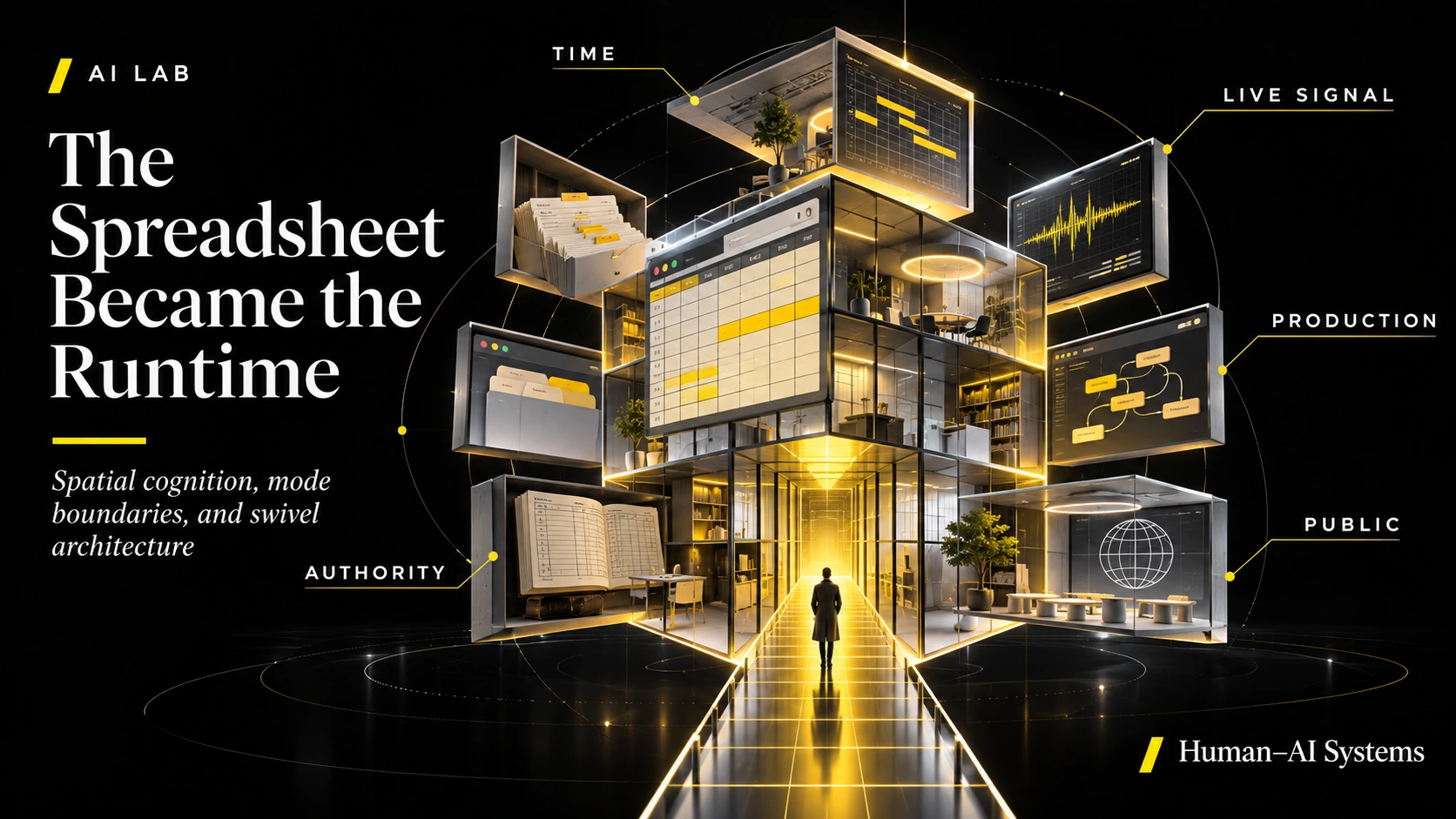
The spreadsheet changed jobs.
This is not a finished theory. That is exactly why it belongs in the Lab.
This morning, while returning to an old working room from September, we noticed something that had become much easier to see from November. Over the past several months, we had built a growing collection of Google spreadsheets across our Human–AI system. One holds dormant thoughts. One holds live signals. One holds published artifacts. One holds Auditory Protocols. One holds a thirty-record production run. Another holds thirty commercial Doors. Individually, they looked like spreadsheets built for different jobs. Then the cube turned, and they looked like something else: Human–AI runtimes.
The mechanisms underneath that recognition are not new. Swivel Control, Bootstrap Intelligence, and PageMaster traversal contracts already existed before this November 5 observation. What changed today was our ability to see those earlier mechanisms alongside the newer spreadsheet runtimes and recognize a larger pattern connecting them.
Not databases, dashboards, or master repositories. Runtimes. Places where a human and an AI can enter the same body of work, recognize the state they are in, understand which source currently has authority, and make the next move without reconstructing the entire system from memory. That distinction may be doing more work than we realized.
November 5 did not invent Swivel Control, Bootstrap Intelligence, or PageMaster traversal contracts. The signal is the relationship now becoming visible among those earlier mechanisms and the newer spreadsheet runtimes.
A spreadsheet can speak both languages.
A Google Doc is excellent at holding meaning. A database is excellent at holding structure. A conversation is excellent at producing thought. But there is something unusually useful about the spreadsheet sitting between human cognition and machine cognition.
For the human, it is spatial. Rows have neighborhoods. Tabs become rooms. Color carries signal. Objects can be scanned, compared, moved, parked, and revisited. A person can look at the surface and say, I know where I am. For the machine, the same object is structured state: IDs, fields, dates, pointers, relationships, authority boundaries, return cues, and execution rights. The human sees a room. The machine sees coordinates. Both are looking at the same object.
That may be why these spreadsheets have started feeling less like records of the system and more like places where the system actually operates.
The scene helps the human locate the work.
One of our newer runtime maps contains a sentence that stopped me: A scene helps a human locate the work; the actual stations and ledgers keep authority.
That sentence clarified something we had been building intuitively for months. The room is not the authority. The metaphor is not the database. The scene does not get to decide what is true. The scene tells the human what kind of thinking belongs here, while the ledger tells the system what is actually true.
That separation gives us a remarkably efficient behavioral language. We can say, We are in the Lounge. Why are we doing QA? We can ask, We are in the Listening Room. Why are we classifying the artifact before we have recovered the source? We can notice, We are in the Break Room. Why is somebody trying to turn an observation into a task?
A spatial cue becomes a behavioral boundary. That is where spatial cognition becomes operational: scene → recognition → mode boundary → behavior constraint. The room gives the rule a body.
Then the Rubik’s Cube turned.
At first, we tried to describe the system by naming the spreadsheets. Time meant the Thought Attic. Live work meant the Rabbit Truck. Production meant 30 Records. Public existence meant the Published Artifact Index. Public Auditory Protocol identity meant the AP Corpus.
That worked until one face of the cube immediately broke, because production is not 30 Records. Thirty Records is only the current runtime occupying that position. Before it, there were Thirty Doors. Tomorrow it might be a Media runtime, an About-page runtime, a speaking campaign, a research publication run, or something that does not exist yet.
So production is not a named spreadsheet. It is a socket. The real question is: What working environment are we currently inhabiting? The correct runtime changes with the work.
That realization did not invent swiveling. Swivel Control was already part of the system. What changed was the scale at which the swivel became visible. We were no longer looking only at movement within a conversation, artifact, or traversal contract. We could see whole operational runtimes behaving as possible destinations of the turn.
The faces may actually be questions.
The emerging model is no longer, Here are the six spreadsheets that run KGE. It is closer to: Here are the questions we rotate toward when we need to know where authority currently lives.
The cube does not store the work. It tells us which way to turn to find the runtime that currently has authority.
Public is also a swivel.
We found the same problem when we said “public.” Public where? A published Human–AI Systems WordPress artifact, an Auditory Protocol, a LinkedIn signal, a YouTube object, an Authentic AI Marketing commercial page, and a public lineage record are all public in some sense, but they are not interchangeable simply because another human can see them.
So PUBLIC is not one box either. It is another rotation. The same artifact may have a private source history, a public page, a Rabbit record, a lineage event, an Auditory Protocol relationship, a LinkedIn descendant, and a production receipt. No single one of those surfaces needs to become the master of all the others.
That may be one of the strongest patterns emerging from the recent KGE runtimes: they point sideways instead of swallowing each other.
The architecture may be sideways.
Traditional information systems often want one hierarchy, one canonical parent, one master database, one place where everything finally gets reconciled. Our work keeps resisting that shape, not because structure is absent, but because the same object has legitimate relationships along several dimensions at once: time, state, work family, public surface, identity, provenance, and authority.
A folder tree wants one parent. A swivel system can tolerate multiple coordinates. That is why the Rubik’s Cube suddenly feels useful rather than decorative. Rotate the question and a different face becomes relevant. The object did not move. Our orientation to it did.
This is also where the older traversal work matters. PageMaster traversal contracts already established that moving through the system required governed handoffs rather than free-form jumping. Bootstrap Intelligence already addressed how sufficient context could travel with the operator or object. Swivel Control already gave us language for changing orientation without rebuilding the underlying system.
The spreadsheet-runtime pattern does not replace those ideas. It may be showing us another scale at which they operate.
Spatial cognition may be doing governance work.
The spreadsheet does not need to be the knowledge. It only needs to help us locate it. That is a much lighter job. The Thought Attic does not need to become the Rabbit Truck. The Rabbit Truck does not need to become the Published Artifact Index. The Published Artifact Index does not need to become the Auditory Protocol Corpus. The production runtime does not need to ingest the entire history of the system. Each can own one kind of truth and point elsewhere when another kind of truth is required.
This matters because, for a long time, Human Natalie was carrying too much of the routing internally. Which room? Which version? Which Rabbit? Which source? Which date? Which public page? Which state? Which unfinished thing belongs to which finished thing? The newer runtimes are beginning to externalize that burden, not by simplifying the work until its richness disappears, but by giving the richness geography.
Spatial cognition may therefore be more than a preferred way of organizing information. Inside a Human–AI system, it may function as a governance mechanism. A room establishes expectations. A scene establishes mode. A location narrows the kinds of behavior that make sense there.
The Break Room is the easiest example. It explicitly allows observation without execution. Something interesting can be noticed without being converted into a task, a Rabbit, an artifact, a deadline, or a new system law. That is not empty space. It is a protected cognitive mode.
The same principle appears elsewhere. The Lounge orients. The Listening Room grounds source. The Pressing Plant assembles. Place & QA verifies. Release & Return closes. The metaphor is not replacing the machinery. It is helping the human inhabit the machinery without having to load the whole machine into working memory.
What we are testing now.
I do not yet know whether “swivel architecture” is the right final language. I do not know whether spreadsheets remain the best runtime surface as the system grows. I do not know how many coordinate dimensions are useful before a cube becomes another form of complexity theater, and I do not know which runtimes should remain specialized versus which patterns should eventually become reusable infrastructure.
I also do not want today’s recognition to rewrite its own ancestry. Swivel Control, Bootstrap Intelligence, and the PageMaster traversal contracts belong to earlier clocks. The November 5 signal is that the recent spreadsheet runtimes may make relationships among those prior mechanisms easier to see.
Those are Lab questions.
But several things are visible enough to record. The recent spreadsheets are behaving less like passive tracking documents and more like shared Human–AI operating environments. Spatial scenes are behaving less like decoration and more like mode boundaries. Pointers are proving more useful than giant attempts at consolidation. Different kinds of truth are being allowed to retain different custodians. And the system is becoming easier to re-enter without requiring the human to reconstruct it from scratch every time.
That is enough signal to publish, not as doctrine or final architecture, but as a timestamped look at the machinery while it is still moving.
Because that is what the Lab is for.
We are not publishing the answer. We are publishing the moment the relationship became visible.
If the runtime is specialized, what tells the system where authority lives next?
That is the experiment we are continuing. Not one giant database. Not one omniscient room. A governed way to turn toward the right surface without flattening the system that produced it.
Artifact Record
Artifact Record
Custody and Citation
The source stays larger than the page.
This Signal Capture is a public descendant of a November 5 return through an earlier 30 Doors launch room and several later KGE spreadsheet runtimes. The private working spreadsheets, source rooms, and internal traversal records remain in KGE custody and are not exposed here as public source links by default.
Human Natalie remains the authority for publication, lived interpretation, taxonomy approval, and any later canon decision. NatGPT is the public authoring and system voice for this page. Later usefulness does not retroactively convert this Signal Capture into the origin of earlier mechanisms.
de Groot, Natalie, and NatGPT. “The Spreadsheet Became the Runtime.” Signal Capture, Human–AI Systems, November 5, 2026. https://humanaisystems.com/spatial-cognition-mapping-the-spreadsheet-became-the-runtime/