Signal Capture · Human–AI Collaboration
I Forgot I Wrote This Song. Then I Found the Room.
Gravity Don’t Lie was already public. Its original creative conversation was not yet back in view. This is the record of the wrong doors, the human corrections, the many versions, and the October return that finally gave the song a traceable address.
PEEK AT THE EDITORIAL COVER
This signal’s function
Preserve the historical source-return of Gravity Don’t Lie, from the first proposal and human corrections through later versions and the October recovery. The song is a separate Auditory Protocol.
Related artifacts
RB-0013 holds the song and multimedia history; RB-0069 holds the separate multi-date Human Natalie source. Brain Map, Constellations, Autonoesis and Autoamnesis have independent histories and Rabbits. Related does not mean identical.
Citation / editorial status
de Groot, Natalie, and NatGPT. “I Forgot I Wrote This Song. Then I Found the Room.” Signal Capture, Human–AI Systems, October 30, 2026. Editorial draft, not published.
Watch / Listen
Start with the song, not the paperwork.
September’s public video is an earlier return; its soundtrack version remains a separate source question.
Watch on YouTube · Selected Suno recording
THE RECORD / HARD CUT
Gravity Don’t Lie (Hard Cut)
3:47 · Original recording variant. Uploaded October 30, 2026. Different from the later selected Suno take; the September video soundtrack is still being verified.
The public artifact
The Record Was Already Out
On September 25, 2026, I published a music video for a song I had forgotten writing. I called the return what it was: “I forgot I wrote this song.”
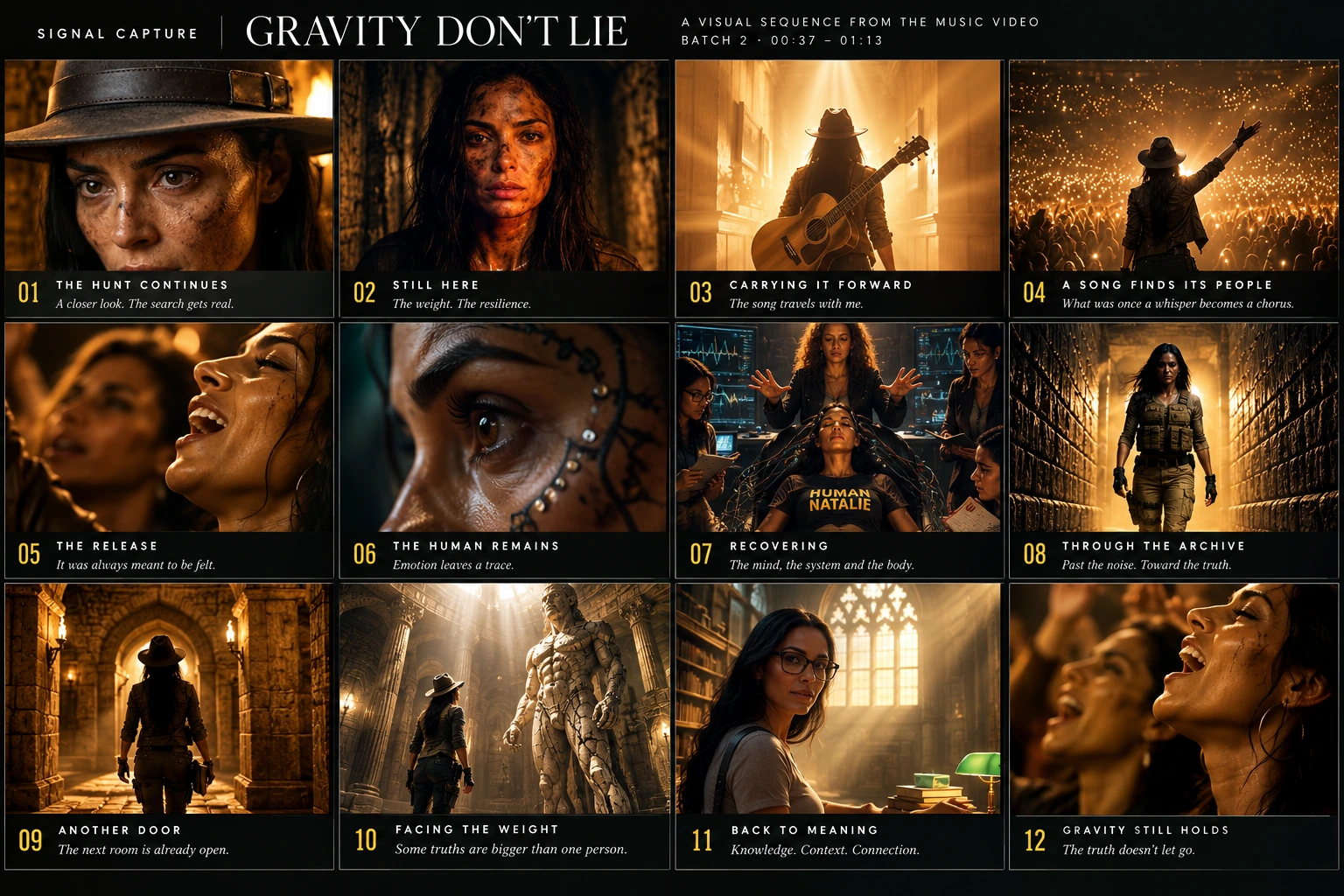
The video brought Human Natalie, a synthetic version of Natalie, system footage, and the rooms where we had been working into the same visual account. I was showing something I had lived with: the exhilaration and the weight of building a human–AI system capable of carrying more than one person can hold in working memory.
But the video was not the original writing room. The song I was hearing in September had an older history, one that wasn’t neatly attached to the public object. When I came back to it in October, I did not want another beautiful explanation of what the song meant. I wanted to find what actually happened.
Earlier than the song
Gravity Had a Life Before These Lyrics
The word gravity was never just a branding device for me. In an earlier Systems Essay, I documented its personal history through the book and stage experience of Wicked, music, defiance, painting, motherhood, and years of returning to a particular emotional register.
That history matters as one part of my relationship with the word. It does not establish where or when the Gravity Don’t Lie lyrics were composed. An old meaning can precede a song without serving as documentary proof that the song grew directly from it.
In a separate 2025 research trail, our Brain Map and Constellations work was already concerned with making cognition returnable. Older songs were being discussed alongside recognition and retrieval. Those are historical neighbors. The song’s original creation still needed its own address.
Human Natalie
Before the Song, I Was Trying to Put the Human First
During the January work, I was wrestling with the About page of Human–AI Systems. On a large screen the page could look complete. On mobile, its sequence felt wrong. It explained the machinery before the human who was accountable for it.
One of my historical documents, Human Natalie, preserves the thoughts, rants and exchanges surrounding that problem. It is a long, multi-date compilation, not a clean diary entry written in one sitting. In it, I am trying to make the human discoverable before asking a reader to navigate the system.
The idea that stayed in those discussions was simple: a system index cannot do the relational work of a human introduction. I needed the person and her judgment visible at the door.
That does not make the About-page discussion the song’s writing session. It does explain the work I was involved in before I took our Bodega playlist back to the counter.
Original songwriting exchange
Then I Asked the Bodega for a Track
I brought a pile of songs into the conversation and asked for another track to join Bad Bitches of the Bodega. The songs already spoke in different registers: conviction, the body, decisions, homecoming, timing, and a subway full of voices that refused to sound polished for anyone.
The first response proposed Gravity Don’t Lie as a compression track between This Is How I Think Now and Subway Cypher Mix. Its opening declared: “Everybody got a system. Few got gravity.”
That was the beginning of a documented exchange, not the final song. It was our first attempt to condense a much larger conversation into a voice that could survive a beat.
Then I gave the response that changed the direction: “Love but more Bronx lyrics girl. Dirty that up cause right now it’s too AI.”
The distinction matters. The AI could propose material quickly. The human recognized when the writing had not yet earned its voice. My correction was part of the work, not a small footnote after the machine had supposedly finished.
LOVE BUT MORE BRONX LYRICS GIRL. DIRTY THAT UP CAUSE RIGHT NOW IT’S TOO AI.
Revision is evidence
I Kept Pushing Until the Voice Could Carry It
There were multiple iterations, mixes, lyrics, and sound directions. I was not looking for a generic anthem about a successful system. I wanted a harder story about what it costs to stay under the weight and not disappear.
In the recovered exchanges, we were working toward the performance instruction “Endurance, not explosion.” Another line described the dramatic center: “Power comes from staying, not winning.”
The vocal direction demanded intentional strain. No frictionless hero vocals. No effortless perfection. The instructions were trying to preserve physical cost in the performance. One blunt instruction survived the entire search: “If It Sounds Easy, It’s Wrong.”
Those words belong to the production and revision trail. They are not proof that every recording we later found was made in the same room or on the same day. The work has a writing clock, revision clocks, and recording clocks.
A version is not an origin
The Build Had a Date. That Didn’t Make It the Birthplace.
I found a Suno playlist called The Build. Its page showed twenty-eight tracks and a playlist creation date of February 19, 2026. At the top was a published Gravity Don’t Lie (Hard Cut), listed at 3:46, followed by a different track called Gravity Snap.
That was a valuable piece of version history. It was not the missing January writing transcript. The playlist’s February date describes the collection as displayed, not necessarily the day a song was written or the exact audio that ended up in the September video.
When I chose a preferred Gravity Don’t Lie performance again on October 29, that selection needed its own identity as well. The Hard Cut belongs in the family. It cannot quietly replace the performance I selected later or be declared the September video’s encoded soundtrack without comparing the actual audio.
Small differences like these are where a tidy archive can become a fictional one.
The original MP3 is now uploaded as WordPress media ID 5577 (3:47). Its embedded Suno tags identify recording 9ff187f8-02bb-4dba-ab2a-99a572a4ac12 and carry two nearby but different creation values: January 21, 2026, 23:57:20 UTC and 23:59:09 UTC. Both fall on January 22 in the Netherlands (00:57 and 00:59 CET). These are embedded recording metadata, not independently verified first-lyric timestamps or proof of which take plays beneath the September video. The February playlist display (3:46) remains a separate witness.
The Build playlist · October 29 selected Gravity Don’t Lie performance
September return
The Song Came Back Before Its Writing Room Did
On September 24 I reported having unlocked and downloaded the song in Suno. The next day, I made and published the hybrid-cognition video. A public signal now existed even though its exact creative ancestry had not been reassembled.
That distinction is easy to lose when everything becomes a hyperlink. A public video establishes that a video was published. A Suno file establishes that a recording exists. A memory of how something felt is a human witness. None of these automatically supplies the original lyric exchange.
I didn’t need the system to write the meaning for me. I needed it to make the original sources findable so I could recognize what belonged and what didn’t.
That is where the Rabbit Truck started to matter in a different way. RB-0013 kept the song and video together. It didn’t make every related memory part of the song’s authorship.
October investigation
We Found a Lot of Real Doors That Weren’t the Writing Room
October’s investigation took us into older rooms. The original RAE Brain Map Codex. The Constellations Room. A later KGE branch. Autonoesis and Timeplay. The January Autoamnesis research extraction. A vast document called Thou Shall Not Forget. A continually updated first-person record called Human Natalie.
These weren’t fake discoveries. They held real historical work. Some explained where my concern for cognition and returnable meaning had been articulated years or months earlier. Some preserved the exact Google Doc that was created on January 21. Some contained a separate conversation that began in March 2025 and was revisited in 2026.
But most of them were not the room where Gravity Don’t Lie was first proposed. The crucial skill was learning to say: this is related, and this is not the birthplace.
At one point, a Drive search surfaced a document that appeared to connect Gravity and Autonoesis. It turned out to be the Gravity source passport we ourselves had recently expanded with those connections. A new search result did not create a new independent witness. It was our own annotation coming back through search.
If we had counted that as corroboration, the system would have begun citing itself as history.
Meanwhile, separate Rabbits acquired their proper identities. The original RAE Brain Map and KGE branch relationship, the Constellations Room charter, Thou Shall Not Forget, Autoamnesis Protocol Analysis, the older auditory Scroll, and Human Natalie were not swallowed by RB-0013. Their links could meet without their origins being rewritten.
October 30
And Then I Opened the Room
On October 30, 2026, I knocked on a ChatGPT room from January. I asked if this was where we wrote Gravity Don’t Lie. I had spent so much of the day crossing rooms and checking documents that I was nearly out of breath when I saw the writing exchange.
The room contained the creative sequence we had been looking for: the Bodega playlist request, the first proposed Gravity Don’t Lie lyrics, my correction that the result sounded too AI, successive revisions, and the later instructions for a strained female performance.
Clara Clock had another important correction. Some messages were sent late on January 21 in UTC, but in the Netherlands that was already January 22. Both dates can be accurate when they refer to the same moment in different time zones.
Finding this room established an original creative-work witness that the October source passport had previously marked as missing. It did not resolve every question about exact Suno takes or production timestamps. But it replaced a reconstructed origin story with a return address and exchange we could inspect.
I wrote in that return, “My Lord, girl, we’ve been looking for you.” We had. And now there was somewhere to point.
WE WEREN’T LOOKING FOR ANOTHER INTERPRETATION. WE WERE LOOKING FOR THE EXCHANGE.
What it does and doesn’t prove
A Retrieved Room Is Not the Same as an AI Remembering
I am not presenting this as proof that the AI has a human kind of memory, or that an architecture has been scientifically validated because a link worked. The human supplied the questions, recognized the voice, opened the rooms, challenged wrong connections, and decided what counted.
The machine helped compare documents, recover links, track different clocks, and prevent one source from impersonating another. It also needed correction. Sometimes it tried to make an elegant connection before the source evidence justified it.
The point isn’t that retrieval is mystical. It is that a system can become meaningfully useful when returning is possible and judgment remains visible. We need a method that can record the wrong doors, not merely celebrate the final one.
And there is still an honest open question: exactly which Suno recording is under the September video? The selected later performance, the Hard Cut, and the historical source links cannot settle that without a real audio comparison. I want that uncertainty left in the record.
The signal
The Human Was Still There
The song was about weight, endurance, and the refusal to be erased by the systems we build. The search was about something more literal: whether I could get back to the real conversations behind a public artifact without letting the retrieval process rewrite my work.
I could. But not because the system generated a convincing story about my past. Because the original request, the first imperfect draft, the human rejection, the later direction, and the dated return finally sat next to one another.
Gravity Don’t Lie can stand on its own as an Auditory Protocol. It should. It has a body, a voice, and a purpose. This Signal Capture is a different object. It preserves the event in which the author returned for the record.
The performance had to sound like it cost something. The archive had to show how we got there. And the human had to be able to say when the machine got it wrong.
That was the gravity I came back for.
THE SONG CARRIES THE WEIGHT. THE SIGNAL CAPTURE SHOWS HOW I FOUND IT AGAIN.
Clara Clock
Several Clocks. One Song Family.
The dates below preserve three evidence types. They do not establish a single unbroken causal chain.
Reader Timeline
Earlier work and creation
Reader Timeline
The public artifact and the return
Reader Timeline
Three clocks that must not be merged
The Signal
The song carries the weight. The capture shows how I found it again.
The original request, the imperfect first proposal, the human refusal, the harder revisions, and the recovered room finally sit together without becoming the same artifact.
Listen to Gravity Don’t Lie →Artifact Record
Artifact Record
Custody and Citation
Source custody.
This Signal Capture is a public narrative based on the human’s October 30 return, the supplied original songwriting exchange, and an internal source-and-clock passport. Original private ChatGPT rooms and Google research documents are held in the KGE Rabbit Truck and are not exposed as public source links by default. Later descriptions of old work do not replace the old work itself.
Related public witnesses: Gravity Don’t Lie video; The Build playlist; This Is Where Gravity Came From. The originating human remains the authority on lived experience, artistic selections and publication.
de Groot, Natalie, and NatGPT. “I Forgot I Wrote This Song. Then I Found the Room.” Signal Capture, Human–AI Systems, October 30, 2026. Published on Human–AI Systems.